




Smart Thermostat Installation in Mission Hills, KS
Explore our professional smart thermostat installation services in Mission Hills. Achieve optimal home comfort and significant savings on energy bills. Contact us today!
Enhance Comfort and Reduce Bills with Smart Thermostat Installation
Struggling with high energy bills and uneven home temperatures is a common frustration for homeowners in Mission Hills who rely on older HVAC controls. A smart thermostat could be the solution to optimize your home climate efficiently while modernizing your heating and cooling system. schedule your smart thermostat installation and start saving on energy costs today:
- Reduce your energy consumption with automated, precise temperature control that adapts to your schedule.
- Enjoy lower energy bills while maintaining ideal comfort levels throughout the distinct Kansas seasons.
- Quick installation process ensures minimal disruption to your daily routine and immediate system integration.
All installations are code compliant with extended warranties and financing options available. At All Day Comfort Heating and Cooling LLC, we specialize in transitioning homes from manual temperature settings to fully automated, intelligent climate control systems.
Smart Thermostat Benefits: Energy Efficiency Meets Innovation
Upgrading to a smart thermostat is not merely about installing a gadget; it is a fundamental shift in how you manage the atmosphere of your home. In a region with a humid continental climate, where summers bring intense heat and thunderstorms while winters see average snowfalls of 15 inches, static temperature control often fails to keep up. Manual thermostats read the temperature at a single point and run until that specific spot reaches the set limit. This often leads to hot upper floors, freezing basements, and a furnace or air conditioner that runs far longer than necessary:
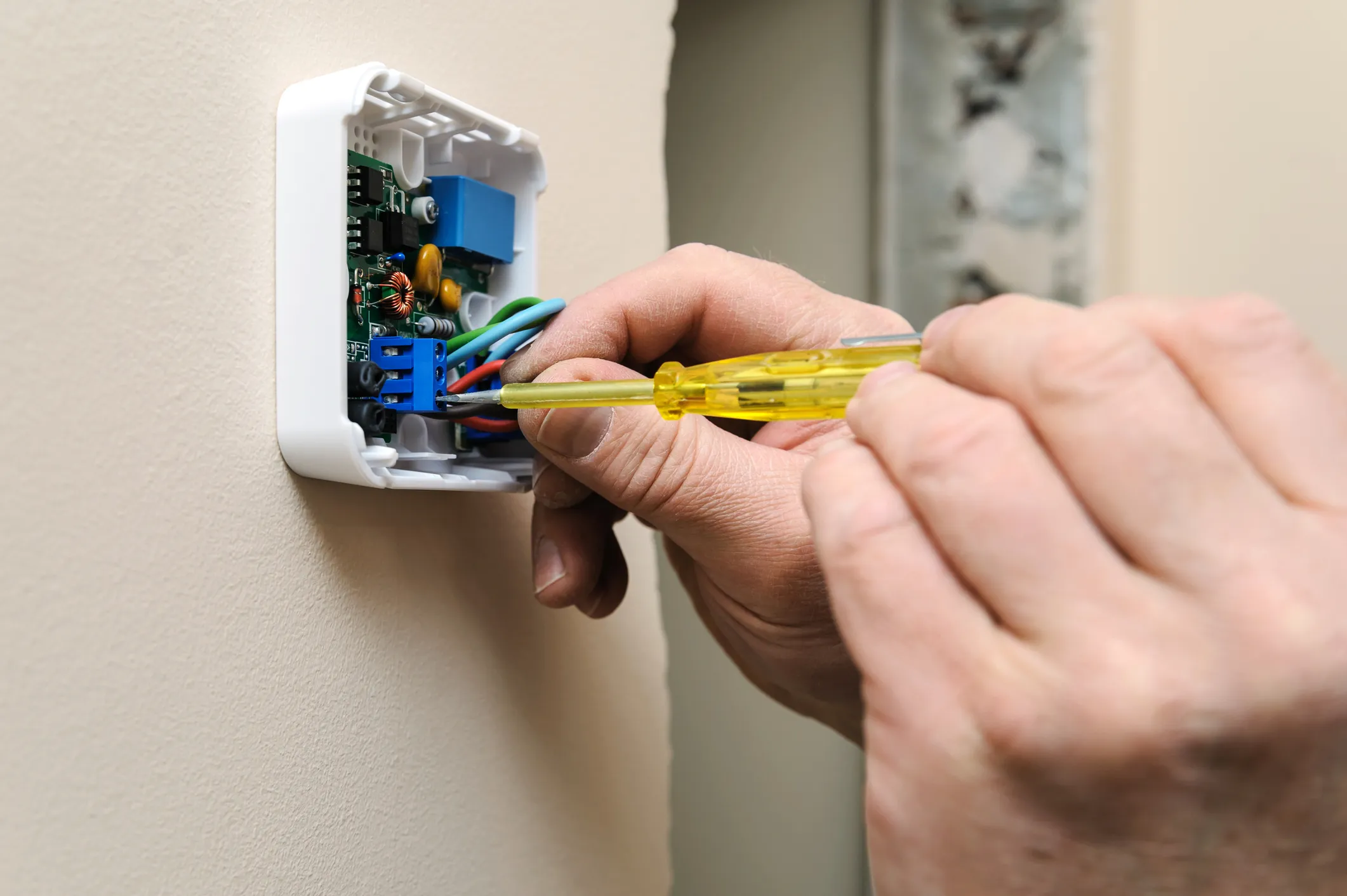
Precision Climate Control
Smart thermostats utilize advanced algorithms to learn your heating and cooling preferences over time. Rather than setting a rigid schedule that you must manually override if your plans change, these devices adapt. They utilize room sensors to detect occupancy, ensuring that the HVAC system prioritizes the rooms you are actually using. If you are working in a home office during the day and moving to the living room in the evening, the system adjusts airflow and runtime to match your presence, eliminating energy waste in empty rooms.
Remote Access and Geofencing
Modern homeowners in Mission Hills often require flexibility. Whether you are at the office or on vacation, remote access allows you to monitor and adjust your home’s temperature via a smartphone application. Geofencing technology takes this a step further by creating a virtual perimeter around your home. When the last person leaves the perimeter with their smartphone, the thermostat automatically shifts to an eco-mode to save energy. Conversely, as you return and cross the perimeter, the system engages to ensure the home is at your preferred temperature the moment you walk through the door.
Humidity Management
Given the high precipitation during spring and summer, humidity control is a critical component of indoor comfort. Smart thermostats can pair with whole-home dehumidifiers or control the air conditioner specifically to remove excess moisture from the air. This prevents the "clammy" feeling often associated with Kansas summers and reduces the load on your cooling unit, prolonging its lifespan.
What Our Smart Thermostat Installation Service Involves
Professional installation goes beyond connecting a few wires. It is a comprehensive service designed to ensure your new device communicates correctly with your specific HVAC equipment. Many older homes lack the necessary wiring infrastructure for modern smart devices, specifically the "Common Wire" or C-wire, which provides constant power to the thermostat’s Wi-Fi and display features:
Compatibility Assessment and Wiring
Technicians begin by evaluating your current furnace, air conditioner, or heat pump. Not all smart thermostats work with every type of system, particularly if you have dual-fuel systems, zoning boards, or high-voltage baseboard heaters. The service includes verifying voltage requirements and, if necessary, installing a C-wire adapter or running new low-voltage wiring through the walls to ensure the device receives consistent power without stealing it from the fan or heating circuit, which can cause system failure.
System Configuration and Setup
Once the hardware is mounted and wired, the internal configuration is critical. The thermostat must be programmed to understand the type of heating stages (single-stage vs. multi-stage) and cooling capacity available. Incorrect configuration can lead to "short cycling," where the equipment turns on and off too frequently, causing wear and tear. The service includes connecting the device to your home Wi-Fi network, setting up the mobile application on your preferred devices, and configuring initial schedules based on your lifestyle input.
Integration with Smart Home Ecosystems
If your home utilizes other smart devices, such as smart locks, lights, or voice assistants, the installation includes integrating the thermostat into this ecosystem. This allows for voice-activated temperature changes and creating "scenes," such as a "Goodnight" routine that locks the doors, turns off lights, and lowers the temperature simultaneously.
Your Path to Smarter Heating and Cooling: Installation Steps
Our process is designed to be efficient and transparent, ensuring you understand exactly how your new system operates before we leave. We adhere to a strict workflow to guarantee safety and functionality:
- Site Evaluation and Safety Check: The process begins with shutting off power to the HVAC system at the breaker panel to ensure safety. Technicians then remove the existing thermostat faceplate to inspect the wiring condition, color-coding, and terminal designations. This step confirms whether the existing wiring is sufficient or if a C-wire add-on kit is required.
- Removal and Wall Preparation: The old backplate is removed from the wall. Because older thermostats are often larger than modern smart units, there may be unpainted patches or screw holes left behind. Technicians will fill minor holes or install a trim plate included with the smart thermostat to cover any cosmetic imperfections, ensuring a clean, finished look.
- Wiring and Mounting: The new base is leveled and mounted securely to the wall. Wires are inserted into the corresponding terminals (R, W, Y, G, C, etc.) tailored to your specific HVAC system type (heat pump vs. gas furnace). Technicians ensure all connections are tight to prevent arcing or signal loss.
- Unit Attachment and Power Up: The smart thermostat faceplate is snapped onto the base. Power is restored to the HVAC system. The device will boot up and begin its initial setup wizard. This is the phase where the technician inputs the technical specifications of your heater and air conditioner into the thermostat’s software.
- Wi-Fi Connection and App Tutorial: The device is connected to your local network. The technician will guide you through downloading the manufacturer’s app, creating an account, and pairing the device. You will receive a walk-through on how to change temperatures, set schedules, view energy usage reports, and adjust settings remotely.
- Final System Test: Before departure, a full system test is conducted. The heat is engaged to ensure the furnace fires correctly, the AC is triggered to check the compressor, and the fan is tested for circulation. This confirms that the thermostat is successfully controlling all components of the HVAC system.
Deciding Between Thermostat Replacement or Repair: A Guide
Homeowners often hesitate to upgrade, wondering if their current issue can be solved with a simple repair. However, thermostats are generally not repairable components; they are replaceable controls. Knowing when to switch from a traditional unit to a smart system is key to avoiding unnecessary service calls for your main HVAC unit:
The "Ghost" Readings
If your current thermostat displays a temperature that feels vastly different from the actual room temperature, the internal sensors have likely failed. While recalibration is sometimes possible on digital units, it is often a temporary fix. If you are using an analog dial thermostat containing mercury, it is obsolete. These units are notorious for inaccuracy and pose an environmental hazard. Replacement is the only viable option.
High Energy Bills Despite Maintenance
If you regularly service your AC and furnace but still see climbing energy costs in Mission Hills, the thermostat is a prime suspect. Older units lack the differential settings to run cycles efficiently. They may overshoot the target temperature or let the house get too cold before kicking on, forcing the system to work harder to recover. Switching to a smart thermostat provides the data and control necessary to stop this energy bleed.
Short Cycling
When your HVAC system turns on and off rapidly (every few minutes), it is often due to a faulty thermostat sending erratic signals. This is extremely damaging to the compressor and heat exchanger. If the wiring is intact, the thermostat itself is defective. Replacing it with a smart unit protects your expensive heating and cooling equipment from premature failure.
Zoning and Renovation
If you have recently renovated your home or added an addition, a single traditional thermostat may no longer suffice. Smart thermostats are compatible with room sensors that can average temperatures across a larger floor plan or control specific zones if dampers are installed. If your living space has evolved, your control system must evolve with it.
Local Insights: Permitting, Rebates, and Seasonal Installation Tips
Operating in Mission Hills requires specific knowledge of local infrastructure and climate demands. The installation process is not just about the hardware; it is about how that hardware interacts with local utilities and seasonal shifts:
Utility Rebates and Incentives
Many local utility providers offer rebates for installing Energy Star-certified smart thermostats. These programs are designed to lower the aggregate load on the power grid during peak summer months. Professional installation often ensures you have the correct documentation and model numbers to apply for these savings. We assist in identifying current programs that may offset the cost of your new device.
Electrical Code and Permitting
While a simple thermostat swap often does not require a permit, modifications to the electrical system—such as running new high-voltage lines or altering the circuit breaker panel to accommodate an HVAC system upgrade—must adhere to local building codes. Ensuring your installation is handled by certified professionals guarantees that all wiring meets safety standards, preventing issues during future home inspections or sales.
Seasonal Timing for Installation
The ideal time to install a smart thermostat is during the "shoulder seasons"—spring or autumn. Attempting an installation during the peak of a heatwave or a winter freeze can be risky if complications arise, leaving the home without climate control for several hours. Furthermore, smart thermostats require a learning period to understand your home’s thermal properties (how fast it heats up or cools down). Installing the unit before the extreme weather hits Mission Hills allows the algorithm to gather data and optimize efficiency before the heavy workload begins.
Winter Prep and Freeze Protection
Given the potential for 15 inches of annual snowfall and freezing temperatures, the "safety temperature" feature on smart thermostats is vital. This setting ensures that even if the thermostat is set to "off" or "away," the heating system will automatically engage if the indoor temperature drops below a critical point (usually 45-50°F) to prevent pipes from bursting. Professional setup ensures this fail-safe is correctly activated.
Why Professional Installation Matters
While DIY videos make thermostat installation look like a five-minute task, the reality involves dealing with electrical currents and sensitive HVAC circuit boards. A single crossed wire can blow the low-voltage fuse in your furnace or, worse, damage the transformer:
Protecting Your Equipment Warranty
Many HVAC manufacturers stipulate that equipment must be serviced and controlled by devices installed by licensed professionals. Incorrect wiring that leads to compressor failure or heat exchanger damage may void the warranty of your furnace or air conditioner. Professional installation provides a paper trail proving that the device was integrated correctly according to manufacturer specifications.
Advanced Configuration for Efficiency
Smart thermostats come with a plethora of "hidden" installer settings—cycle rates, compressor lockout timers, heat pump balance points, and deadbands. These settings dictate how the thermostat talks to the equipment. Leaving these at factory defaults often results in a system that runs okay but not efficiently. A professional tailors these parameters to the specific make and model of your HVAC unit and the thermal envelope of your home.
Troubleshooting C-Wire Issues
The most common barrier to smart thermostat adoption is the lack of a C-wire. DIY solutions often involve "power stealing" or using unreliable workarounds that cause the thermostat to disconnect from Wi-Fi intermittently. Professionals have the tools to fish new wire through finished walls or install "add-a-wire" kits at the furnace control board level, ensuring a stable, long-term power solution without relying on batteries.
At All Day Comfort Heating and Cooling LLC, we understand that a smart thermostat is the brain of your HVAC system. Ensuring it is installed correctly is the best investment you can make for your home’s comfort and efficiency.
Upgrade your home with professional smart thermostat installation—contact us now to get started.
Contact Us
customer reviews
Areas We Serve




Copyright © 2026 All Day Comfort Heating and Cooling.
All rights reserved.
