




Duct Installation in Olathe KS
Address your home's HVAC inefficiencies with our professional duct installation services in Olathe. Ensure even temperatures and reduced bills. Contact us today!
Inconsistent Airflow and Rising Energy Bills Demanding Attention?
Are you facing unexpected HVAC issues due to Olathe's unpredictable cold snaps or humid summers, leaving certain rooms in your home uncomfortable while others are perfectly fine? Do you need a reliable and quick duct installation service to ensure your system's efficiency and eliminate the strain on your heating and cooling unit? Contact us immediately to schedule a comprehensive assessment or apply for financing to get your system running correctly today.
Homeowners dealing with aging or improperly sized ductwork often face skyrocketing utility costs and inconsistent temperatures. Replacing these vital components is not just about comfort; it is about protecting the longevity of your furnace and air conditioner. Our team prioritizes precision and speed to restore your home environment.
- Receive a same-day service guarantee for urgent duct problems that compromise your home’s safety or comfort.
- Work with top-rated local technicians who ensure a thorough, code-compliant, and professional installation.
- Benefit from our straightforward pricing structure and transparent project scopes with no hidden fees.
All services are backed by a comprehensive warranty and are fully compliant with local building codes. All Day Comfort Heating and Cooling LLC is dedicated to providing the structural solutions your HVAC system needs to perform at its peak.
Today's Services: Fast Installation and Accurate Scoping
When you commit to a duct installation or replacement today, you are purchasing a permanent solution to airflow restrictions and energy waste. The primary goal is to create a sealed, balanced pathway for air to travel from your mechanical equipment to every corner of your living space — request service today.
The scope of a standard installation involves much more than simply swapping out metal or flexible tubing. It begins with a comprehensive evaluation of your home’s layout. Technicians calculate the necessary cubic feet per minute (CFM) of airflow required for each room. This ensures that a bedroom on the second floor receives the same level of comfort as the living room on the main floor.
Regarding timelines, most residential duct installations are completed within one to three days, depending on accessibility and the complexity of the system. If your home has a crawlspace or attic that is difficult to navigate, the timeline may adjust slightly, but the objective remains a swift restoration of service.
The installation package typically includes:
- Removal and eco-friendly disposal of old, contaminated, or rusted ductwork.
- Fabrication or sourcing of custom sheet metal plenums and transitions.
- Installation of supply and return runs sized according to Manual D standards.
- Sealing of all joints and connections with mastic or metal tape to prevent air leakage.
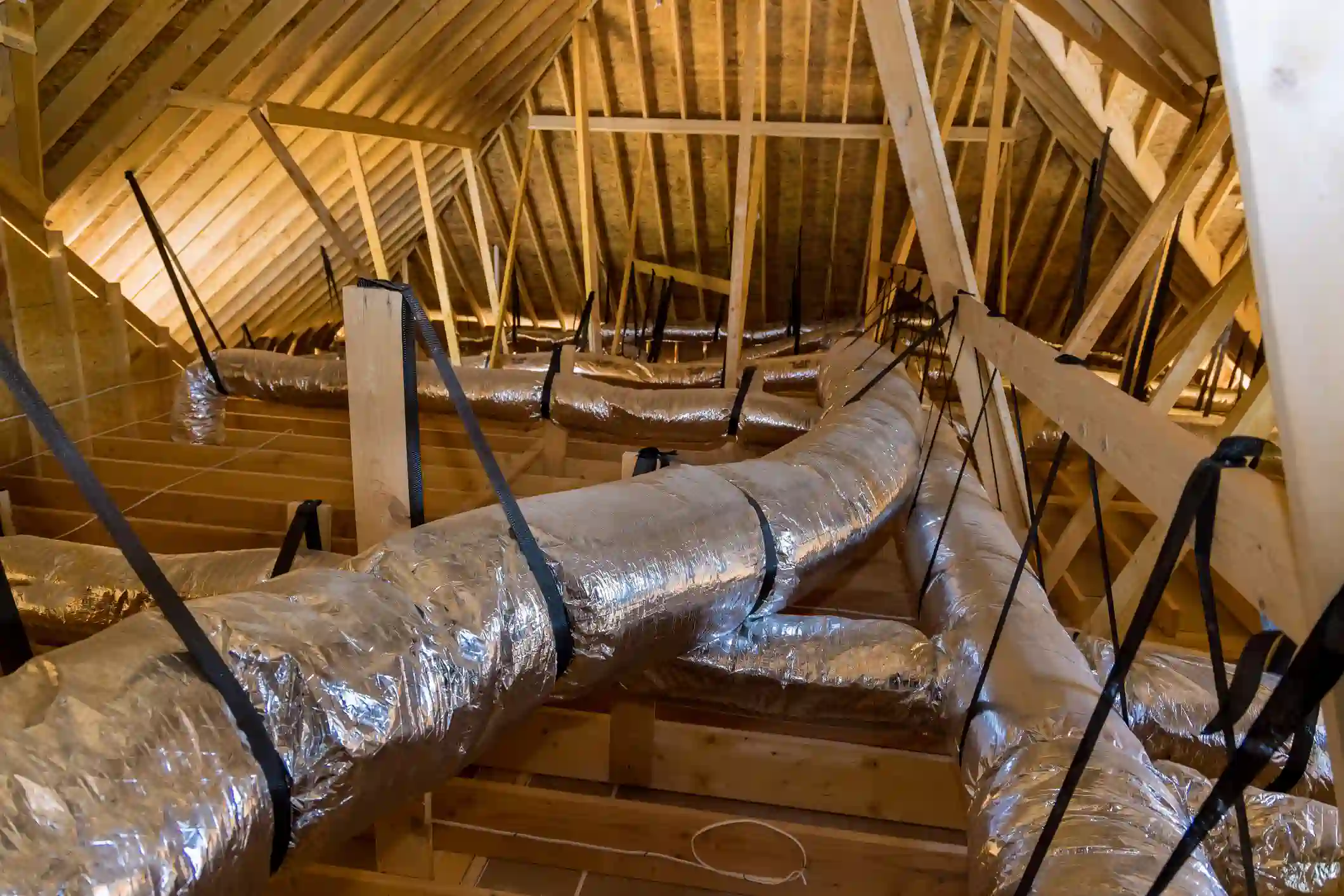
- Insulation of ductwork in unconditioned spaces to prevent thermal loss and condensation.
- Final airflow testing to verify static pressure and system balance.
Our Duct Installation Process Explained
A professional installation follows a strict sequence to ensure the system operates quietly and efficiently for decades. We do not skip steps or rely on guesswork; every bend and run is calculated.
Load Calculation and Design
The process begins with a Manual J load calculation. This determines exactly how much heating and cooling your home requires. Based on this, a Manual D calculation is performed to design the duct system. This ensures the ducts are the correct size to handle the airflow without creating excessive noise or back-pressure on the blower motor.
Site Preparation and Removal
Technicians protect your floors and furniture before beginning work. The old system is carefully dismantled. This step is critical for identifying any underlying issues, such as mold growth, rodent intrusion, or structural damage in the framing that needs to be addressed before new ducts are placed.
Fabrication and Layout
The main trunk line is installed first. This is the central artery of your HVAC system. In many local Olathe homes, this requires custom sheet metal work to fit specific basement or attic dimensions. The trunk is secured with heavy-duty hangers to prevent sagging, which can disrupt airflow and cause pooling of condensate.
Branch Installation
Once the trunk is secure, the branch lines—the ducts that lead to individual registers—are connected. Depending on the application, rigid sheet metal or high-quality flexible ductwork is used. Rigid metal is preferred for its durability and airflow characteristics, while flex duct is utilized in tight turns or final connections to boots.
Sealing and Insulating
Mechanical connections alone are not airtight. Technicians apply professional-grade mastic sealant or UL-181 foil tape to every seam, joint, and collar. If the ducts run through an attic, crawlspace, or garage, they are wrapped in insulation. This prevents the air you paid to heat or cool from gaining or losing temperature before it reaches your rooms.
Venting and Returns
Proper return air is just as important as supply air. The team installs return drops and grilles to ensure the HVAC unit is not "starving" for air. Without adequate return pathways, the system creates negative pressure, drawing in outdoor pollutants and reducing efficiency.
Testing and Balancing
Finally, the system is tested. Technicians measure static pressure and airflow at each register. If one room is getting too much air while another gets too little, dampers are adjusted to balance the system. This ensures uniform comfort throughout the entire property.
Deciding Between Duct Replacement and Repair
Homeowners often struggle to decide whether their existing ductwork can be salvaged with repairs or if a full replacement is necessary — read our FAQs. While minor leaks can be sealed, there are specific scenarios where replacement is the only financially sound option.
Age of the System
If your ductwork is over 15 to 20 years old, the seals have likely deteriorated, and the insulation has lost its R-value. Older systems often lack the design efficiency of modern standards. If you have recently upgraded to a high-efficiency furnace or air conditioner, old ducts may be unable to handle the airflow, causing the new unit to short-cycle or fail prematurely.
Severe Contamination
Ducts that have been subjected to moisture, leading to extensive mold growth, often cannot be fully cleaned. Mold infiltrates the insulation of fiberboard ducts or the liner of flex ducts. In these cases, replacement is required to protect indoor air quality. Similarly, if there has been a significant rodent infestation, the damage to the structure and the sanitary risks usually necessitate a full tear-out.
Design Flaws and Comfort Issues
If your home has always had hot or cold spots, the issue is likely the design, not the equipment. Undersized ducts restrict airflow, creating high static pressure that kills blower motors. If the original installation did not account for the length of runs or the number of bends, no amount of sealing will fix the airflow problem. Replacement allows for a redesign that corrects these fundamental errors.
Damage and Deterioration
Metal ducts can rust, and flexible ducts can collapse or tear. Plastic outer liners on flex ducts in hot attics can become brittle and disintegrate. If you see crushed sections, disconnected joints that cannot be reattached, or extensive rust, replacement is the more durable solution.
Understanding Olathe's Climate Needs and Regulations
Local environmental factors heavily influence how ductwork should be installed in this region. Olathe experiences significant temperature swings, from sub-freezing winters to sweltering, humid summers. This specific climate profile dictates strict requirements for insulation and sealing.
Humidity Control
Summer humidity levels in Kansas can be oppressive. When cold air travels through ducts located in unconditioned spaces like attics or crawlspaces, condensation (sweating) can form on the exterior of the ducts if they are not properly insulated. This moisture can drip onto ceilings, causing water damage and encouraging mold growth. Professional installation includes high R-value insulation and vapor barriers specifically designed to combat this local issue.
Winter Efficiency
During winter, heat loss from leaky ducts in a basement or attic means your furnace must run longer to satisfy the thermostat. This increases wear on the heat exchanger. Properly sealed metal ducts maximize the delivery of warm air, ensuring your heating system can keep up during January cold snaps without driving up gas or electric bills.
Permitting and Codes
Johnson County and the City of Olathe have adopted specific mechanical codes that govern HVAC installations. These codes dictate the type of materials allowed, the support spacing for duct runs, and the required insulation values. A professional installation ensures full compliance with these regulations. This is critical not only for safety but also for future home sales, as unpermitted work can flag during inspections.
Technicians ensure that all installations meet the International Mechanical Code (IMC) adjustments adopted by local municipalities. This includes proper clearances from combustible materials and adequate sizing for return air pathways.
Why Choose Our Expertise?
Selecting a contractor for duct installation involves finding a partner who understands building science, not just someone who can hang sheet metal. The efficiency of your expensive heating and cooling equipment is entirely dependent on the quality of the distribution system.
We focus on the technical details that invisible impacts comfort. This includes strict adherence to Manual D sizing protocols and the use of commercial-grade sealing materials that do not degrade over time. Many "budget" installations rely on duct tape, which eventually dries out and fails. We utilize mastic sealant, a fibrous paste that hardens into a permanent, airtight bond.
When you hire All Day Comfort Heating and Cooling LLC, you are choosing a team that views your home as a complete system. We analyze how the ductwork interacts with your insulation, your windows, and your HVAC unit to provide a holistic solution. Our technicians are trained to identify hidden bypasses where air is escaping and correct them during the installation process.
We also prioritize the use of rigid sheet metal wherever possible. While flexible duct is cheaper and easier to install, it has higher resistance to airflow and is more prone to kinking and damage. By maximizing the use of smooth metal trunk lines and runs, we ensure higher airflow velocity and better static pressure management.
Furthermore, we understand the disruption that construction work causes in a home. Our process is designed to be low-impact. We utilize drop cloths, wear shoe covers, and perform daily cleanups to ensure your living space remains livable throughout the project. The goal is to leave you with improved air quality and comfort, without the lingering mess.
Take the Next Step for Your Home's Airflow
Inefficient ductwork acts as a bottleneck for your entire HVAC system, wasting money and reducing comfort. Do not let leaks, poor design, or aging materials compromise your living environment any longer. At All Day Comfort Heating and Cooling LLC, we provide secure system that delivers consistent temperatures and clean air to every room in your house.
Contact us today to schedule your ductwork evaluation and installation.
Contact Us
customer reviews
Areas We Serve




Copyright © 2026 All Day Comfort Heating and Cooling.
All rights reserved.
