




Water Heater Service in Olathe KS
Experiencing cold showers? Contact us for rapid water heater repair or installation in Olathe, KS. Ensure your home's comfort with our expert, licensed services.
Waking Up to Freezing Water Is Not an Option
Is your morning shower colder than usual? You might be facing a failing water heater that requires immediate professional attention before a minor leak becomes a flooded basement. Contact us immediately to schedule a diagnostic visit or inquire about financing options to restore your hot water today.
When you lose access to hot water in Olathe, KS, it disrupts everything from sanitation to daily comfort. A malfunctioning unit demands a swift, decisive response to prevent water damage and restore normalcy to your home.
- Get a precise diagnosis and repair service dispatched in under 24 hours.
- Enjoy the peace of mind that comes with our comprehensive labor and parts warranties.
- Flexible financing options make necessary repairs and system upgrades affordable immediately.
At All Day Comfort Heating and Cooling LLC, all services are fully licensed, ensuring every repair or installation meets strict local building codes and permit requirements for your safety.
Comprehensive Diagnostics and Repair Services
When a water heater fails, the root cause often lies deep within the mechanical or electrical components of the system. Homeowners frequently encounter symptoms like lukewarm water, strange rumbling noises, or puddles forming around the base of the unit. These are critical indicators that internal components are compromising the system’s integrity. Addressing these issues immediately protects the longevity of the appliance and ensures your home remains functional.
Our technicians arrive equipped to handle specific failures common to both gas and electric units. For electric water heaters, the issue is often traced to burnt-out heating elements or a malfunctioning thermostat. If one element fails, the unit may still produce warm water, but it will run out quickly. We test the resistance on upper and lower elements and verify thermostat calibration to ensure the unit heats to the desired temperature without overheating.
For gas water heaters, the focus shifts to the pilot assembly, thermocouple, and gas control valve. A bad thermocouple is a frequent culprit when the pilot light refuses to stay lit, shutting down the entire system for safety. We inspect the burner assembly for soot buildup, which can impair heat transfer, and check the flue for proper venting to prevent carbon monoxide back-drafting.
Our scope of repair also covers the plumbing connections surrounding the unit. Leaking distinct valves, corroded flex lines, and faulty Temperature and Pressure (T&P) relief valves are common failure points. The T&P valve is a critical safety feature; if it is weeping or stuck, it requires immediate replacement to prevent dangerous pressure buildup inside the tank. All Day Comfort Heating and Cooling LLC technicians carry a wide inventory of parts to resolve these mechanical failures on the first visit whenever possible.
The Water Heater Installation Process
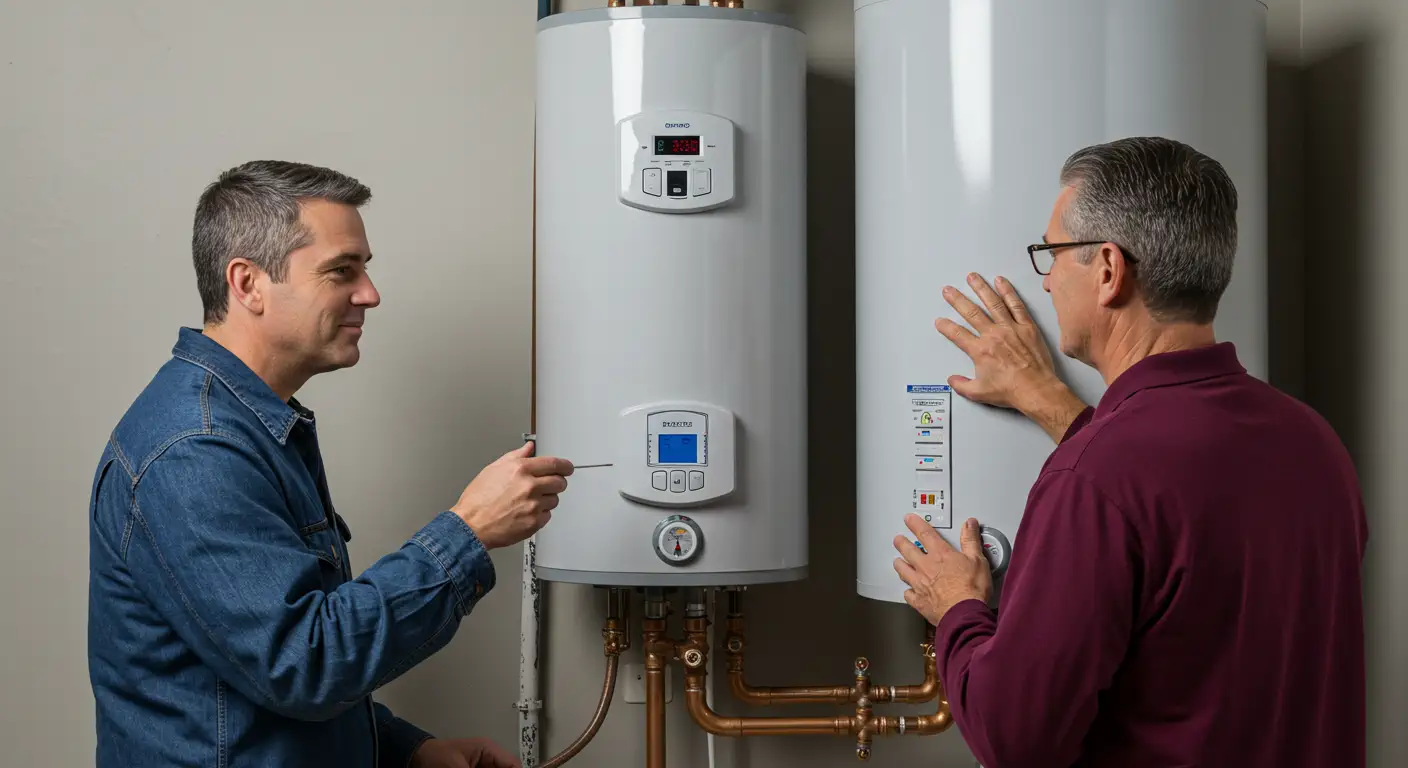
Replacing a water heater is a complex plumbing and safety task that requires adherence to specific protocols. It is not merely swapping one box for another; it involves configuring gas lines, electrical voltage, and water pressure systems to function harmoniously. We follow a strict, standardized procedure to ensure every installation is safe, efficient, and code-compliant — request service today.
- Site Assessment and Sizing: The process begins with evaluating your current demand and available space. We calculate the First Hour Rating (FHR) required to meet your household’s peak usage. This ensures you do not purchase a unit that is too small for your needs or inefficiently large. We also measure the physical footprint to ensure the new unit meets clearance requirements for ventilation and maintenance access.
- Safe Draining and Disconnection: Before removing the old unit, safety is the priority. We shut off the fuel source (gas or electricity) and the cold water supply. The tank is then drained completely via a hose connected to a floor drain or exterior outlet. This step removes hot water and sediment, making the tank safe to maneuver. We then disconnect the venting, water lines, and gas or electrical connections with precision to avoid damaging existing infrastructure.
- Positioning and Connection: The new unit is positioned using a drain pan if required by local code or location (such as in finished areas). We connect the cold water inlet and hot water outlet, often installing new dielectric unions to prevent galvanic corrosion between dissimilar metals. For gas units, we reconnect the gas line using a fresh sediment trap and test the connection for leaks using a digital detector or bubble solution.
- Venting and Safety Checks: Proper venting is non-negotiable for gas systems. We ensure the draft hood is aligned correctly and that the vent pipe maintains the proper upward slope to expel combustion gases safely. We also install a discharge tube on the T&P relief valve, directing it toward the floor to prevent scalding in the event of a discharge.
- Filling and System Testing: Once connected, we fill the tank with water, opening a hot water faucet elsewhere in the house to bleed air from the system. This prevents "dry firing" the heating elements in electric units. Once full, we restore power or ignite the pilot. The system is then monitored through a full heating cycle to verify the thermostat shuts off correctly and that there are no leaks at any joint.
Deciding Between Repair and Replacement
Determining whether to invest in a repair or commit to a full system replacement is a financial and practical decision. While a repair is often cheaper upfront, pouring money into a failing asset can result in higher long-term costs. There are specific criteria that help determine the most logical path forward.
- Age of the Unit: The average lifespan of a traditional tank water heater is between 8 and 12 years. If your unit is approaching or has surpassed the 10-year mark, major repairs are rarely cost-effective. Internal corrosion usually accelerates at this age, and a new part will not stop the tank from eventually leaking.
- Frequency of Breakdowns: If you have required service more than once in the last year, the unit is signaling systemic failure. Repeated repairs suggest that multiple components are reaching the end of their lifecycle simultaneously. In this scenario, replacement offers reliability and resets the warranty coverage.
- Visible Rust and Leakage: Rusty water coming from the hot side tap indicates corrosion inside the glass-lined tank. Once the steel tank begins to rust or leak from the body (not a connection point), it is non-repairable. This is an immediate replacement scenario to prevent catastrophic failure and water damage to your home.
- Efficiency Considerations: Older units often suffer from heavy sediment buildup at the bottom of the tank. This layer of calcification acts as an insulator, forcing the burner or element to work harder to heat the water. This results in higher utility bills and slower recovery times. Upgrading to a modern, high-efficiency model can offset the installation cost through monthly energy savings.
Considerations for Tankless Water Heaters
Many homeowners are transitioning to tankless (on-demand) water heating systems. These units heat water only when it is needed, rather than storing 40 or 50 gallons of hot water standby. This switch requires specific considerations regarding your home's infrastructure.
- Infinite Hot Water Supply: The primary advantage is continuous hot water. As long as you have fuel and water, the unit will produce hot water. This is ideal for households with high consecutive usage, such as back-to-back showers and laundry loads.
- Energy Efficiency: Because there is no standby heat loss (energy used to keep a tank hot while no one is home), tankless units can be significantly more efficient. This is particularly relevant during weather extremes when a tank in a cold garage or basement loses heat rapidly.
- Retrofit Requirements: Switching from a tank to a tankless system often requires upgrading the gas line to a larger diameter to support the high BTU demand of the instant burner. Additionally, venting requirements change, often necessitating distinct PVC intake and exhaust piping. Electrical outlets may also need to be installed for the digital controls and ignition.
- Maintenance Needs: Tankless units require annual flushing to remove scale buildup on the heat exchanger. This is more critical than with tank units, as scale can restrict flow and cause the unit to throw error codes or shut down.
Local Factors Impacting Your Water Heater
Operating a water heater in Olathe presents specific challenges driven by regional climate and water quality. Understanding these local variables helps in selecting the right unit and maintaining it properly.
- Winter Temperature Fluctuations: The region experiences cold winters with lows dipping to 15°F. This drops the temperature of the incoming groundwater significantly. A water heater must work much harder in January than in July to raise that near-freezing water to a comfortable 120°F. This thermal shock increases wear on heating elements and burners. If your unit is located in an unconditioned space, like a garage, it is vital to ensure pipes are insulated to prevent freezing and improve efficiency.
- Hard Water and Sediment: The local water supply can carry high levels of minerals. Over time, calcium and magnesium precipitate out of the water when heated, settling at the bottom of the tank. This sediment buildup creates popping or rumbling sounds and can cause the bottom of a gas tank to overheat and crack. Regular flushing is essential in this area to preserve the life of the tank.
- Permits and Code Compliance: Local building codes in Johnson County are strict regarding water heater installations. Regulations cover aspects such as proper venting materials, expansion tank installation to handle thermal expansion, and seismic strapping in some contexts. An installation performed without a permit or not up to code can complicate the future sale of your home and may void manufacturer warranties. We ensure every job is filed and inspected according to local statutes.
Why Professional Service Matters
Attempting DIY repairs on water heaters involves significant risks regarding gas lines, carbon monoxide, and high-voltage electricity. Professional service ensures that these hazards are managed by trained experts.
- Safety Assurance: Gas leaks are invisible and odorless without additives. Incorrectly taped threads or unaligned flares can lead to dangerous accumulation of gas. Our technicians use electronic sniffers to verify absolute seal integrity. Similarly, working with 240-volt electrical connections in a wet environment requires adherence to strict safety lock-out/tag-out procedures.
- Proper Sizing and Settings: We ensure the unit is set to a safe temperature (usually 120°F) to prevent scalding while still inhibiting bacterial growth (Legionella) inside the tank. We also verify that the expansion tank is pressurized correctly to match the home’s water pressure, protecting your pipes from stress.
- Long-Term Support: A professional installation comes with labor warranties that back the quality of the workmanship. If a fitting leaks or a pilot fails shortly after service, you have recourse. We provide the documentation needed to register your manufacturer warranty, ensuring you are covered for parts replacement in the future.
Restore Hot Water Quickly with Trusted Local Professionals
When your water heater fails, you need a solution that is fast, permanent, and safe. Do not settle for lukewarm showers or risk water damage from a corroded tank. Trust All Day Comfort Heating and Cooling LLC to provide the expert diagnosis and installation services required to keep your home running smoothly.
Contact us now to schedule your water heater service and restore your home’s comfort.
Contact Us
customer reviews
Areas We Serve




Copyright © 2026 All Day Comfort Heating and Cooling.
All rights reserved.
