




Heating Installation in Grain Valley, MO
Ensure your Grain Valley home stays warm this winter with professional heating installation. Contact us today for quick, effective service and financing options.
Experiencing Heating Issues in Cold Weather?
Facing a Grain Valley winter with a faulty or outdated heating system can be more than uncomfortable; it can be downright hazardous. Don’t wait out the cold; resolve your heating needs quickly and efficiently by calling us or applying for financing today. Unpredictable weather patterns in Missouri mean your home requires a reliable, robust thermal barrier against freezing temperatures. When a furnace fails or operates inefficiently, it impacts your utility bills, indoor air quality, and peace of mind. All Day Comfort Heating and Cooling LLC specializes in restoring warmth to your home through precise, code-compliant heating installation.
- Rapid, professional installation ensuring warmth within hours.
- Cost-effective solutions that match your budget and energy efficiency needs.
- 24/7 service availability for emergency replacements and installations.
Licensed and insured professionals with straightforward financing options available.
Understanding the Scope of Professional Heating Installation
Installing a new heating system involves much more than simply swapping one metal box for another. It requires a comprehensive assessment of your home's thermal characteristics to ensure the new unit performs optimally for decades. Many homeowners in Grain Valley suffer from comfort issues not because their furnace is bad, but because it was sized or installed incorrectly. A professional installation addresses the entire heating ecosystem, from the gas lines and electrical connections to the ductwork and thermostat integration.
Standard installation services include a full load calculation. This engineering process determines exactly how much heat your home loses in winter and gains in summer. Factors such as insulation levels, window quality, square footage, and even the direction your house faces impact this calculation. Skipping this step often results in purchasing a unit that is too large or too small. An oversized unit will short-cycle, turning on and off frequently, which wears out components and fails to dehumidify the air. An undersized unit will run continuously without ever reaching the set temperature on the coldest days of the year.
The scope of work also covers the safe removal and disposal of existing equipment. Old furnaces often contain heavy metals or refrigerants that require specific handling protocols. Once the old unit is gone, the installation team prepares the site. This includes modifying the plenum (the box connecting the furnace to the ductwork) to fit the new equipment, sealing connections to prevent air leaks, and ensuring the flue pipe is properly sized and routed to vent dangerous combustion gases like carbon monoxide safely outside.
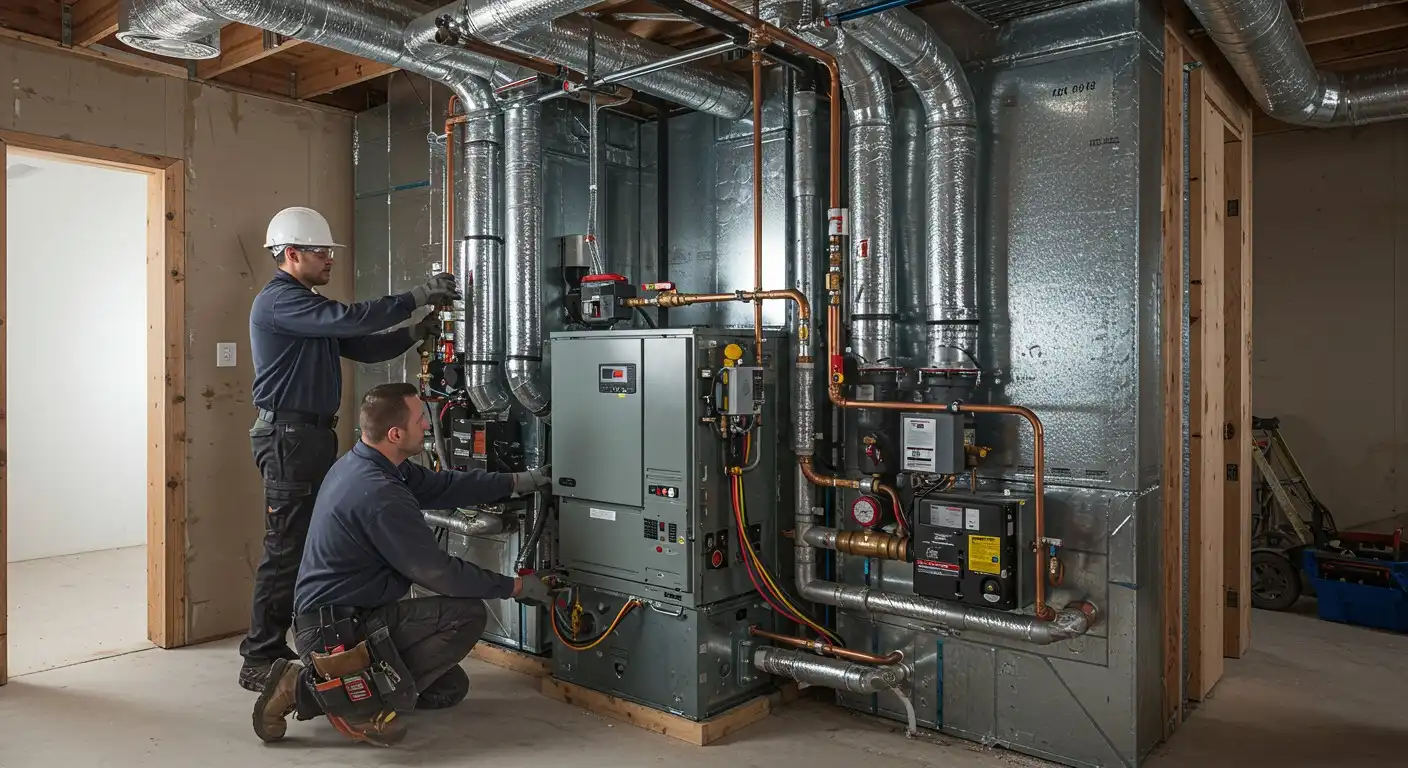
The Installation Process: From Assessment to Ignition
A structured installation process ensures that nothing is overlooked and that your home is returned to a comfortable temperature as efficiently as possible. This workflow is designed to minimize disruption to your daily life while adhering to strict safety standards.
- The process begins with a site evaluation and load calculation. Technicians measure the home and inspect the current ductwork system to identify any airflow restrictions or leaks that might hinder the performance of high-efficiency equipment.
- Next, the workspace is prepared. Floor runners and drop cloths are used to protect flooring and furniture. The gas supply and electrical power are shut off to the existing unit to ensure safety during the extraction phase.
- The existing furnace or heat pump is disconnected and removed. This step involves carefully cutting disconnection boxes, gas piping, and flue pipes. The old unit is hauled away for recycling or proper disposal.
- Technicians then position the new equipment. Leveling the unit is critical for proper drainage, especially for high-efficiency condensing furnaces that produce water as a byproduct of combustion. If the unit is not level, safety switches may trip, causing the heat to shut off.
- Once positioned, the critical connections are made. The supply and return plenums are sealed to the new unit. Gas lines are reconnected with a new sediment trap (drip leg) to protect the gas valve from debris. Electrical wiring is updated to meet current codes, and the thermostat is wired to communicate correctly with the new system.
- Venting is installed or upgraded. High-efficiency furnaces often require PVC venting out the side of the house rather than the metal flue going up the chimney. This piping must be pitched correctly to allow condensation to drain back to the furnace.
- Finally, the system undergoes a startup procedure. This is not just flipping a switch. Technicians measure gas pressure, static pressure in the ductwork, and temperature rise (the difference between air entering and leaving the furnace) to ensure the unit is running within the manufacturer’s specified range.
When to Replace vs. Repair Your Heating System
Deciding between another repair bill and a full replacement is a common dilemma for homeowners. While repairs can solve immediate problems, there is a tipping point where continuing to patch an old system becomes financially irresponsible. Understanding the lifecycle of heating equipment helps in making an informed decision before a catastrophic failure occurs during a deep freeze.
- Age of the Equipment: The average lifespan of a gas furnace is between 15 and 20 years, while heat pumps typically last 10 to 15 years. If your system is approaching or has exceeded this range, parts are likely becoming obsolete, and the heat exchanger—the critical component separating combustion gas from breathable air—is at higher risk of cracking.
- Frequency of Breakdowns: If you have required repairs more than twice in the last two years, the system is signaling the end of its reliable service life. The cost of cumulative repairs often approaches the cost of a down payment on a new, warrantied system.
- Rising Energy Bills: As heating systems age, they lose efficiency. Parts wear out, friction increases, and heat transfer becomes less effective. If your usage habits haven’t changed but your utility bills in Grain Valley are climbing steadily, the equipment is likely wasting fuel.
- Comfort Issues: Uneven heating, where some rooms are boiling while others are freezing, indicates that the system can no longer effectively distribute air. This can be due to a failing blower motor or a heat exchanger that can no longer sustain the necessary temperature rise.
- Safety Concerns: Rust, corrosion, or cracks in the heat exchanger are non-negotiable reasons for replacement. These issues can lead to carbon monoxide leaks, posing a direct threat to the occupants of the home.
- The 50% Rule: A general guideline used in the industry is that if the cost of the repair equals 50% or more of the value of the system (or the cost of a new one), replacement is the smarter financial move.
Choosing the Right System: Furnaces vs. Heat Pumps
The climate in this region subjects homes to a wide variety of weather conditions, from humid summers to sub-zero winter nights. This variability makes the choice of heating technology crucial. Homeowners typically choose between gas furnaces, electric furnaces, or heat pumps, often creating hybrid systems for maximum efficiency.
- Gas Furnaces: These are the most common heating source in areas with natural gas infrastructure. Modern gas furnaces are categorized by their Annual Fuel Utilization Efficiency (AFUE). A standard efficiency furnace is 80% AFUE, meaning 20% of the heat energy is lost up the flue. High-efficiency models reach up to 98% AFUE, converting nearly every dollar of gas into heat. These units use sealed combustion chambers and secondary heat exchangers to extract maximum energy.
- Heat Pumps: A heat pump moves heat rather than generating it. In the winter, it extracts heat energy from the outdoor air (even when it’s cold) and transfers it inside. In the summer, it reverses the process to act as an air conditioner. Modern heat pumps are capable of heating effectively even when temperatures drop below freezing. However, for extreme cold, they are often paired with a gas furnace (dual fuel) or an electric resistance strip (auxiliary heat) to ensure comfort during the harshest weather events.
- Variable Speed and Modulating Technology: Older systems operated at one speed: 100% on or 100% off. This results in temperature swings and loud blasts of air. All Day Comfort Heating and Cooling LLC recommends considering two-stage or modulating equipment. These systems can run at lower capacities (e.g., 40% or 60%) to maintain a constant temperature, resulting in quieter operation, better humidity control, and lower energy consumption.
Local Considerations for Heating Installation
Operating in Grain Valley and the surrounding region requires knowledge of specific local codes, permit requirements, and climate challenges. A generic installation approach that might work in a milder climate will often fail here when the weather turns severe.
- Permits and Inspections: Most municipalities, including Grain Valley, require a building permit for HVAC replacements. This ensures that the installation meets safety codes regarding gas piping, electrical grounding, and venting. A professional installer manages the permit application and schedules the final inspection with the city or county to verify compliance.
- Utility Rebates: Local utility providers often offer rebates for upgrading to high-efficiency equipment. These programs change annually and have specific AFUE or SEER requirements. Navigating these rebates requires documentation that a licensed contractor provides upon completion of the job.
- Insulation and Envelope: The effectiveness of a heater is directly tied to the home's insulation. In this region, where wind chills can be significant, ensuring that ductwork running through unconditioned spaces (like attics or crawlspaces) is heavily insulated is vital. Without this, heat is lost before it ever reaches the living space.
- Drainage Requirements: High-efficiency furnaces produce condensation. In our climate, this water must be drained properly to prevent freezing. If the drain line exits the house, it must be protected from freezing temperatures, or it will back up and shut down the furnace.
The Importance of Ductwork Modifications
A new, high-performance engine cannot perform well in a car with flat tires. Similarly, a high-efficiency furnace cannot deliver comfort through a compromised duct system. Ductwork is the circulatory system of your home’s HVAC. Over time, ducts can separate, develop leaks, or accumulate dust and debris.
- Static Pressure Analysis: High-efficiency equipment is sensitive to airflow restrictions. If the existing ducts are too small, the new blower motor will work harder, use more electricity, and fail prematurely. Modifications to the return air drop or the supply plenum are often necessary to accommodate the increased airflow requirements of modern filtration systems.
- Sealing and Insulation: Leaky ducts can account for up to 30% of energy loss. Sealing joints with mastic or foil tape ensures that the air you paid to heat actually reaches the rooms.
- Zoning Systems: For multi-story homes, a single thermostat often leaves the upstairs hot and the basement cold. Zoning installation involves placing dampers in the ductwork to control airflow to specific areas independently. This allows for customized temperature control on different floors, increasing overall comfort and efficiency.
Post-Installation Support and Warranties
The relationship with your service provider shouldn't end when the truck drives away. The longevity of your heating investment depends on the quality of the warranty and the availability of ongoing support. Manufacturer warranties typically cover parts for 10 years, but this coverage is often contingent on proof of professional installation and annual maintenance.
- Labor Warranties: While the manufacturer covers the metal and electronics, the labor warranty covers the workmanship. This protects you from costs associated with installation errors or early failures requiring technician time.
- Registration: Most equipment requires product registration within 60 to 90 days of installation to receive the full warranty term. Failing to register can revert a 10-year warranty down to a 5-year warranty. A reputable installer handles this registration process for you.
- Maintenance Plans: Modern heating systems contain sensors and control boards that benefit from regular calibration. Establishing a maintenance routine immediately after installation ensures the system retains its efficiency rating and keeps the warranty valid.
Why Professional Execution Matters
The Department of Energy states that the quality of installation is just as important as the equipment brand. A top-tier brand installed poorly will underperform a mid-tier brand installed perfectly. Precision in gas pressure settings, refrigerant charge (for heat pumps), and airflow balancing dictates the actual efficiency you receive.
Choosing a provider that prioritizes technical accuracy over speed ensures that your home remains safe and warm. We focus on the details—measuring twice, cutting once, and verifying every safety switch before signing off on the job. From the initial load calculation to the final explanation of your new thermostat, the goal is a seamless transition to a better heating experience.
Restore Safe, Reliable Heat in Grain Valley
A failing or outdated heating system is more than an inconvenience during Grain Valley’s harsh winters—it is a direct threat to your comfort, safety, and budget. By investing in a properly sized, professionally installed furnace or heat pump, you eliminate frequent breakdowns, uneven temperatures, and escalating utility bills. Comprehensive installation, ductwork optimization, and ongoing support ensure that your new system performs efficiently for years to come.
All Day Comfort Heating and Cooling LLC is ready to deliver dependable, code-compliant heating installation tailored to your home and the Missouri climate. Secure your warmth and peace of mind today—contact All Day Comfort Heating and Cooling LLC to schedule your heating installation consultation and explore flexible financing options.
Contact Us
customer reviews
Areas We Serve




Copyright © 2026 All Day Comfort Heating and Cooling.
All rights reserved.
