



Heating Installation in Lee's Summit, MO
Installation within 24 hours in Lee's Summit. Our licensed technicians provide fast, professional heating installation with comprehensive warranties. Learn more.
Quick and Efficient Heating Installation Services
Is your old heater failing to cope with the cold Lee's Summit winters, leaving your home uncomfortable and your energy bills high? We provide reliable heating installations within 24 hours direct to your doorstep; contact us today to secure your new system and restore warmth to your home immediately.
When temperatures drop in Missouri, waiting days for a replacement isn't an option. You need a solution that is installed correctly, functions efficiently, and ensures the safety of your family. Our approach prioritizes speed without sacrificing technical precision:
- Same-day heating system installations for urgent needs.
- Comprehensive warranties and transparent pricing.
- Licensed and insured technicians ensuring professional service.
This service includes full compliance with local codes and attractive financing options to fit your budget.
What You Get With a Standard Installation
When you invest in a new heating system, you are purchasing more than just a metal box; you are paying for a comprehensive comfort solution that includes the equipment, the labor, and the necessary auxiliary components to ensure the system runs safely. A proper installation is critical because even the highest-rated furnace will fail prematurely if installed incorrectly.
Our installation scope covers the entire lifecycle of the replacement project. This begins with the safe disconnection and removal of your existing unit. We handle the disposal of the old equipment in accordance with environmental regulations, ensuring no debris is left on your property.
The core of the service involves the installation of the new heating unit. This includes leveling the equipment to ensure proper drainage of condensate (for high-efficiency units) and reduced vibration. We fabricate and install a transition plenum to connect the new unit to your existing ductwork seamlessly. An airtight seal at this connection point is vital to prevent air leakage, which can significantly reduce system efficiency and comfort.
We also address the critical connections that power the system. This involves reconnecting the gas lines with fresh pipe dope and testing for leaks immediately. Electrical connections are inspected and re-terminated to ensure they meet current voltage requirements. If your new system requires a different venting configuration—common when upgrading from an 80% efficiency unit to a 90%+ efficiency unit—we install the necessary PVC intake and exhaust piping, routing it safely to the exterior of the home.
All installations include a new thermostat integration or configuration of your existing controls to ensure compatibility with the new hardware. We verify that the thermostat correctly cycles the equipment through all stages of heating.
The System Replacement Process
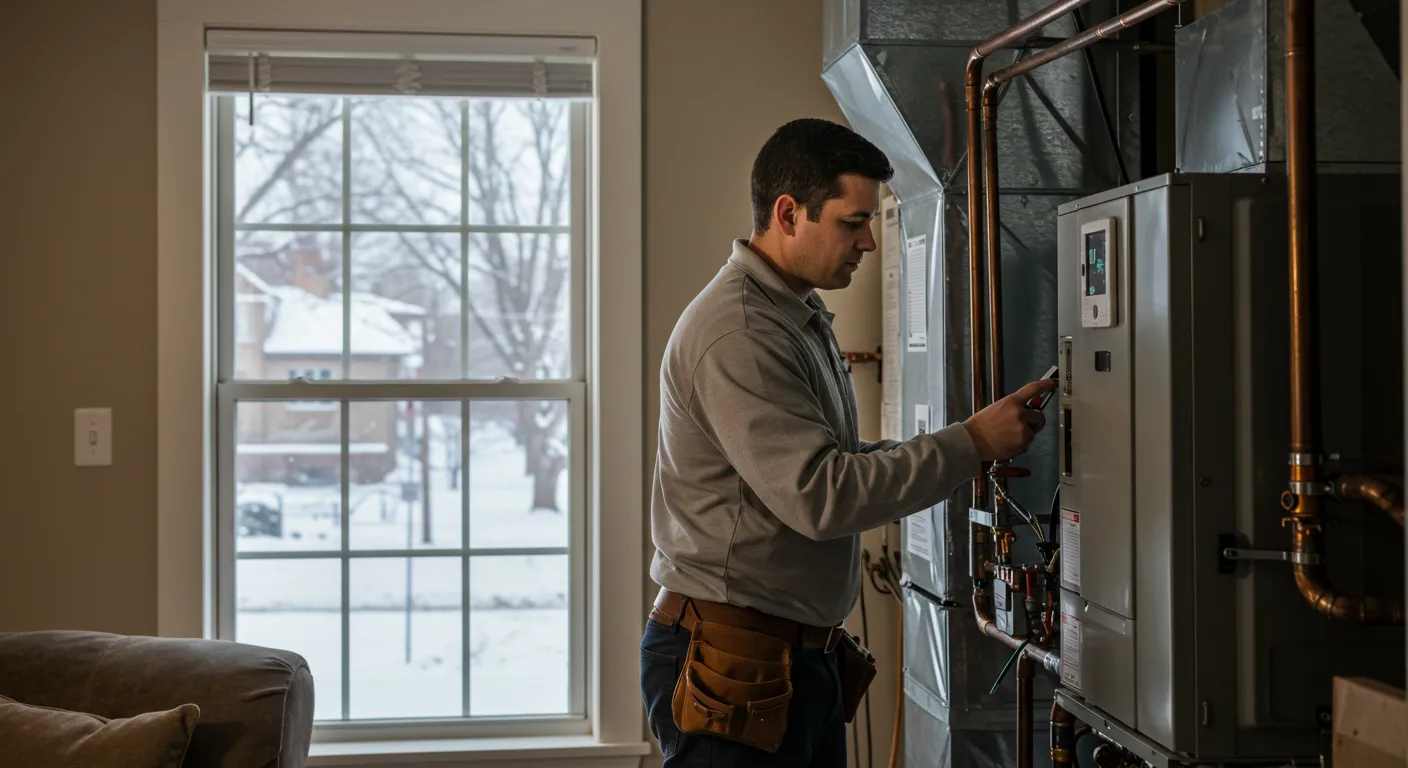
Understanding the timeline and steps involved in a heating replacement helps remove the stress from the experience. We follow a strict protocol to ensure consistency and quality control on every job site in Lee's Summit:
- First, a technician performs a Manual J load calculation. This is a technical assessment of your home’s square footage, insulation levels, window quality, and orientation. This step ensures the new unit is sized exactly for your home’s thermal needs, preventing "short cycling" (oversized units) or inability to keep up (undersized units).
- Next, we provide a clear proposal detailing the specific equipment model, the efficiency rating (AFUE), and the scope of work. Once approved, we schedule the installation, often available for same-day or next-day deployment depending on stock availability.
- The installation team arrives with all necessary equipment, including drop cloths and shoe covers to protect your flooring. They begin by isolating the electrical and gas supplies for safety before dismantling the old system.
- Once the old unit is removed, the team inspects the immediate ductwork and the evaporator coil (if you have central AC) to check for blockages or mold growth that could impede the new heater’s performance.
- The new unit is moved into place, and all gas, electric, and flue connections are established. We specifically focus on the static pressure of the airflow. If the static pressure is too high, the blower motor will overwork and fail early. We adjust the fan speed and duct transitions to bring this pressure within manufacturer specifications.
- Finally, we perform a rigorous commissioning sequence. This involves measuring the temperature rise—the difference between the air entering the return and the air leaving the supply. This number must match the manufacturer’s data plate to ensure the heat exchanger is not overheating.
- The process concludes with a walkthrough. We show you how to operate the new interface, how to change the filter, and review the warranty documentation before leaving the site.
When Replacement Beats Repair
Deciding between repairing a breakdown or investing in a new system is a financial calculation based on equipment age, safety, and future reliability. While repairs can solve immediate issues, they often serve as temporary bandages on a failing system:
The Age Factor
Heating systems typically have a lifespan of 15 to 20 years. If your furnace is approaching or has passed the 15-year mark, parts availability becomes scarce, and major components like the blower motor or control board become disproportionately expensive. At this stage, efficiency has likely degraded, meaning you are paying more for fuel to generate the same amount of heat.
The Cost of Repair vs. Replacement
We recommend following the "50% Rule." If the cost of the repair equals or exceeds 50% of the cost of a new system, replacement is the smarter financial move. For example, if a compressor or heat exchanger fails, the labor and part cost is significant. Putting that money toward a new unit with a fresh warranty offers a better return on investment than fixing a dying machine.
Safety Considerations
The most critical factor is the condition of the heat exchanger. This metal chamber contains the combustion gases (carbon monoxide and nitrous oxide) and transfers heat to your household air. Over time, the constant expansion and contraction from heating cycles can cause cracks in the metal. A cracked heat exchanger allows deadly carbon monoxide to leak into your living space. If a crack is detected, the unit must be shut down immediately. In this scenario, replacement is almost always the only safe option, as replacing a heat exchanger is labor-intensive and costly.
Rising Energy Bills
If you have noticed a steady increase in your gas or electric bills despite usage remaining constant, your system’s Annual Fuel Utilization Efficiency (AFUE) has likely dropped. Older units may operate at 60-70% efficiency, meaning 30-40 cents of every dollar you spend on gas is wasted up the flue. Modern systems start at 80% and go up to 98% efficiency. The monthly savings on utility bills often offset the monthly payment of a financed installation.
Local Installation Factors and Requirements
Installing heating equipment in our region requires specific attention to local climate patterns and municipal regulations. The weather here shifts dramatically, requiring systems that can handle deep freezes in January without losing capacity:
Permitting and Codes
In this area, HVAC replacements generally require a building permit. This is not just a formality; it is a consumer protection mechanism. The permit triggers a third-party inspection by the city or county to ensure the gas piping is leak-free, the electrical work is grounded, and the venting meets safety standards. We handle the entire permitting process, from application to scheduling the final inspection, ensuring your home remains compliant with local ordinances.
Utility Configurations
Different neighborhoods utilize different utility providers. Whether your home is serviced by Spire for natural gas or Evergy for electricity, we ensure the equipment selected matches the fuel source and voltage available at your property. For homes in rural areas relying on propane, we perform the necessary gas valve conversion to ensure the furnace burns propane safely and efficiently, as propane burns hotter than natural gas.
Ductwork Challenges
Many older homes in the area have ductwork originally sized for heating-only systems or smaller A/C units. Modern high-efficiency furnaces move more air to achieve their ratings. All Day Comfort Heating and Cooling LLC assesses your existing ductwork to ensure it can handle the airflow of the new equipment. If the ducts are undersized, we may recommend specific modifications to the return air drop to prevent noise issues and equipment strain.
Seasonality and Scheduling
The busiest times for heating failures are the first cold snap of the year and the depths of January. Proactive replacement during the shoulder seasons (fall) can often result in faster scheduling. However, because we understand that failures often happen at the worst times, our logistics are set up to prioritize no-heat situations when the safety of the home is at risk due to freezing pipes or low indoor temperatures.
Technical Expertise and Workmanship
The difference between a system that lasts 10 years and one that lasts 20 years is often the quality of the installation. We adhere to strict industry standards that go beyond the basic code requirements:
- Brazing Standards: When installing heat pumps or systems with AC coils, we purge nitrogen through the lines while brazing. This prevents oxidation (soot) from forming inside the copper pipes, which can later clog the sensitive metering devices in the system.
- Electrical Safety: We use high-quality wire nuts and verify all connections are torqued to spec. Loose electrical connections are a leading cause of intermittent failures and fire hazards.
- Gas Piping: We verify gas pressure at the manifold. If the pressure is too high or too low, the burner will not operate correctly, leading to soot buildup or erratic shutdowns. We use digital manometers to dial this in to the exact tenth of an inch of water column.
- Venting Slope: For high-efficiency condensing furnaces, the PVC exhaust pipe must slope back toward the unit to allow condensation to drain. Improper slope causes water to pool in the pipe, which will trip the pressure switch and shut down the heat. We ensure precise grading on all vent runs.
We maintain a clean job site. Heating installations can be messy, involving soot, dust, and metal shavings. Our technicians use drop cloths to create a path to the equipment and vacuum the workspace upon completion. The goal is to leave the area cleaner than we found it.
Secure Your Comfort Today
A reliable heating system is a necessity, not a luxury. Delaying the replacement of a failing unit risks a total breakdown during the coldest part of the year, potential water damage from frozen pipes, and safety hazards regarding carbon monoxide.
By choosing professional installation, you ensure that your home remains a sanctuary against the elements. You gain the peace of mind that comes with manufacturer warranties, labor guarantees, and a system operating at peak efficiency. We prioritize getting your heat back on with minimal disruption to your daily life.
All Day Comfort Heating and Cooling LLC is ready to assess your needs and provide a permanent solution to your heating challenges. Don't wait for the temperature to drop further; secure your installation now.
Contact Us
customer reviews
Areas We Serve



Copyright © 2026 All Day Comfort Heating and Cooling.
All rights reserved.
