




Heating Maintenance in Prairie Village, KS
Ensure your furnace is ready for Prairie Village winters with our expert maintenance. Contact us now for safety checks, efficiency boosts, and reliable warmth.
Is Your Furnace Prepared for the Upcoming Freeze?
As temperatures in Prairie Village begin to plummet, reliance on your heating system shifts from a luxury to an absolute necessity for safety and comfort. If your heater is making strange noises, cycling frequently, or simply failing to maintain the set temperature, you need a solution that restores efficiency before the heavy winter weather settles in. Book your comprehensive system inspection and maintenance today.
When the cold snaps hit Kansas, an unmaintained furnace is a liability. Without regular attention, small issues like dirty sensors or loose electrical connections can escalate into total system failure right when you need heat the most. Our service focuses on preventative care that stabilizes your system, ensuring consistent warmth throughout the season:
- Same-day service availability to restore your home's temperature control without delay.
- Transparent pricing structures and clear financing options to make maintenance decisions easy.
- Thorough safety inspections and performance tuning that extend the operational lifespan of your equipment.
All Day Comfort Heating and Cooling LLC is fully licensed and insured, backing our work with satisfaction guarantees to ensure your total peace of mind.
What You Get With Professional Maintenance
Heating maintenance is often misunderstood as a quick visual check, but a true tune-up involves a rigorous, multi-point inspection and calibration process designed to return your unit to factory specifications. The goal is not just to turn the unit on, but to maximize the energy efficiency of every cycle. When a technician services your equipment, the focus is on the three pillars of heating performance: safety, airflow, and combustion efficiency.
Safety is the primary concern. Gas furnaces burn fuel to create heat, and this process produces byproducts like carbon monoxide. A critical part of maintenance involves inspecting the heat exchanger for cracks or corrosion. Even a hairline crack can allow hazardous gases to mix with the air circulating through your home. We also test safety switches and limit controls. These mechanisms are designed to shut the furnace down if it overheats or if the flame rolls out of the combustion chamber. Verifying their functionality is essential for protecting your property and family.
Combustion efficiency ensures you are getting the most heat for your money. Over time, burners can become clogged with dust and sediment, leading to uneven flames and wasted fuel. We remove and clean the burners, adjust the gas pressure to manufacturer recommendations, and clean the flame sensor. A dirty flame sensor is a common cause of furnaces shutting off prematurely (short cycling), which puts immense strain on the internal components.
Airflow calibration is the final piece of the puzzle. If air cannot move freely through the system, the heat exchanger can overheat, and your rooms will not reach the desired temperature. This involves more than just changing a filter. We inspect the blower motor, check the capacitor (which gives the motor the torque to start), and measure the amperage draw to ensure the motor isn't working harder than it should. We also inspect the ductwork connection points for visible leaks that might be bleeding heat into your basement or attic.
How The Maintenance Process Works
Understanding what happens during a service visit helps you prepare and ensures you know exactly what you are paying for. We have streamlined our process to be thorough yet efficient, respecting your time while leaving no component unchecked:
Arrival and Initial Assessment
The technician arrives at your property fully equipped with diagnostic tools. The process begins with a discussion about any specific issues you have noticed, such as cold spots in certain rooms, unusual odors, or increasing utility bills. We then perform a test run of the system to hear how it starts up and operates before opening the cabinet.
Electrical and Mechanical Inspection
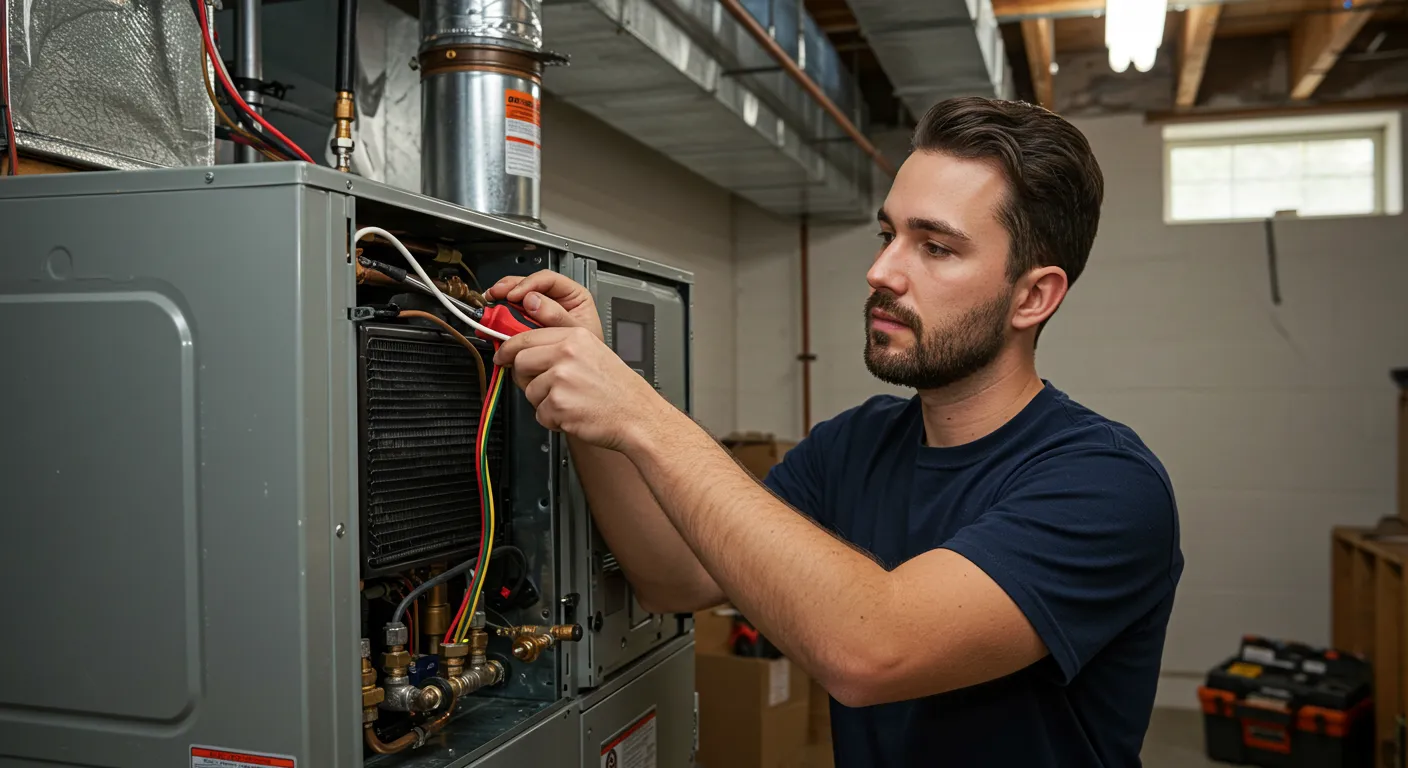
Power is turned off to the unit to safely inspect internal components. We tighten all electrical connections; loose wires can cause arcing, burnt connectors, and intermittent failures. We lubricate moving parts within the blower motor and inducer draft motor if they are not permanently sealed. Reducing friction in these motors reduces electricity usage and prevents overheating.
Combustion Analysis and Cleaning
For gas furnaces, we analyze the flue gases to ensure proper venting. We inspect the flue pipe for rust, obstructions, or back-drafting. The pilot light or hot surface igniter is tested for weak operation. The burners and flame sensor are cleaned to ensure a strong, blue flame. If you have a heat pump, this step involves checking refrigerant levels and ensuring the reversing valve—which switches the unit from cooling to heating—is actuating correctly.
Thermostat and System Calibration
We check the calibration of your thermostat to ensure it is reading the room temperature accurately. If your thermostat reads 70 degrees but the room is actually 66, your system will run longer than necessary. We also check the anticipator settings on older thermostats.
Final Reporting
Once the physical work is done, we restart the system and let it run through a full cycle. We measure the temperature rise (the difference between the air going into the return and the air coming out of the supply). This data confirms the system is heating effectively. You receive a detailed report outlining exactly what was done, the condition of your parts, and any recommendations for proactive repairs if we find components that are near the end of their life.
When Replacement Beats Repair
While maintenance can extend the life of a heating system significantly, there comes a point where keeping an old unit running is no longer financially prudent. Identifying the crossover point between "worth fixing" and "time to replace" helps you avoid throwing money into a dying machine:
- Age of the System: The average lifespan of a gas furnace is between 15 and 20 years, while heat pumps generally last 10 to 15 years. If your system is approaching or has passed these milestones in Prairie Village, major repairs are rarely worth the investment. Parts may be obsolete or expensive to source, and the efficiency of the unit is likely far below modern standards.
- Frequency of Breakdowns: If you have required repairs more than once in the last two years, the system is becoming unreliable. Repeated failures often indicate that the internal components are wearing out in succession. Fixing one part puts stress on the next weakest link, leading to a cycle of continuous payments.
- The 50% Rule: A general guideline in the industry is the 50% rule. If the cost of a necessary repair approaches 50% of the cost of a brand-new unit, replacement is the smarter financial choice. A new unit comes with a fresh warranty, whereas a repair only guarantees that specific part.
- Rising Energy Bills: Heating systems lose efficiency as they age. If your usage habits haven't changed but your energy bills have spiked, your furnace is working overtime to produce the same amount of heat. All Day Comfort Heating and Cooling LLC can perform an efficiency audit to show you how much a new, high-efficiency model could save you on monthly utility costs.
- Safety Concerns: If our inspection reveals a cracked heat exchanger, replacement is almost always the mandatory path. Repairing a heat exchanger is costly and often temporary. Because this issue poses a direct carbon monoxide threat, immediate replacement is the only way to ensure household safety.
Local Notes: Managing Heating in the Region
Operating a heating system in Johnson County requires understanding the specific environmental factors of the region. The local climate is classified as humid continental, which brings four distinct seasons, but the transition from autumn to winter can be abrupt:
- Humidity and Comfort: While winters are cold, the region experiences significant precipitation and humidity shifts. In the winter, the air inside the home can become extremely dry as the furnace runs constantly. This dry air can make the air feel colder than it actually is, prompting homeowners to turn up the thermostat. Integrating a whole-home humidifier with your heating maintenance can improve comfort and allow you to keep the thermostat lower, saving energy.
- Snow and Venting: January is typically the snowiest month, with an average accumulation that can impact your heating system. High-efficiency furnaces vent through PVC pipes on the side of the house. Heavy snowfall or drifts can block these intake and exhaust pipes. If the intake is blocked, the furnace will shut down as a safety precaution. Regular maintenance includes identifying where your vents are located and advising on how to keep them clear during snowstorms.
- Utility Rebates and Programs: Local utility providers often offer rebate programs for upgrading to high-efficiency heating systems or for performing energy audits. Keeping your system maintained ensures you meet the efficiency standards often required to qualify for these incentives. We stay updated on current offers from providers servicing the area to help you maximize potential savings.
- Permitting and Codes: While standard maintenance usually does not require a permit, if a significant repair or full replacement is identified, local building codes come into play. Adherence to these codes regarding gas line sizing, flue pipe clearance, and electrical grounding is not optional. We ensure that any work extending beyond basic cleaning and tuning complies strictly with local regulations to avoid issues when you eventually sell your home.
- Housing Stock Considerations: Many homes in this area are older, with charm and character but also with outdated insulation or ductwork design. Leaky ducts in unconditioned spaces like attics or crawlspaces can result in a 20% to 30% loss of thermal energy. Our maintenance inspections often uncover these structural inefficiencies that aren't the fault of the furnace itself but severely impact its performance.
Why Professional Execution Matters
Choosing a service provider for heating maintenance is a decision that affects your comfort, wallet, and safety. The difference between a quick "blow-and-go" service and a professional technician lies in the depth of the diagnostic process and the transparency of the results:
- Technical Expertise: Modern heating systems rely heavily on electronics and complex logic boards. A technician must be adept at reading wiring diagrams and understanding the sequence of operations. We employ advanced diagnostic tools, such as combustion analyzers and digital manometers, to get precise readings rather than guessing based on sound or sight.
- Respect for Property: Heating equipment is often located in finished areas of the home, basements, or tight utility closets. We utilize drop cloths and shoe covers to protect your flooring and ensure the workspace is left as clean as we found it. The goal is to provide a service that is invisible in terms of mess but noticeable in terms of comfort.
- Long-Term System History: By sticking with a professional provider, you build a history of your system’s performance. We keep detailed records of every pressure reading and temperature split. This allows us to spot trends over time. For example, if the blower motor amp draw is creeping up year over year, we can predict a failure before it happens, rather than reacting to it on a freezing night.
- Warranty Preservation: Most manufacturer warranties require proof of annual maintenance by a licensed professional to remain valid. If a major component fails under warranty, the manufacturer may ask for service records. We provide the documentation you need to protect your investment and ensure your warranty claims are honored.
Protect Your Home with a Comprehensive Furnace Tune-Up
Maintaining your heating system is the single most effective way to prevent unexpected breakdowns and ensure your home remains a sanctuary against the harsh winter elements. Don't wait until the first blizzard to discover your furnace isn't up to the task. Secure your comfort and safety now.
Contact All Day Comfort Heating and Cooling LLC to schedule your comprehensive heating inspection and tune-up.
Contact Us
customer reviews
Areas We Serve




Copyright © 2026 All Day Comfort Heating and Cooling.
All rights reserved.
