




Duct Installation in Raymore, MO
Struggling with uneven temperatures and high energy costs in Raymore? Get expert ductwork evaluation and repair services. Schedule your assessment today.
Uneven Temperatures and Rising Energy Costs Often Point to Ductwork Failure
Is your home feeling uncomfortably hot or cold, no matter how much you fiddle with the thermostat? You might have issues with your ductwork that need professional attention. Homeowners in Raymore often attribute comfort issues to the furnace or air conditioner, but the delivery system—your air ducts—is frequently the actual culprit behind poor performance and wasted energy. Contact us today to schedule a comprehensive duct evaluation or to discuss our flexible financing options.
When you choose All Day Comfort Heating and Cooling LLC for your ductwork needs, you move beyond temporary patches and address the root cause of airflow restriction. A properly installed duct system transforms the way your home handles the drastic temperature shifts common in Missouri, ensuring that the air you pay to condition actually reaches your living spaces.
- Ensure optimal air flow and comfort with professional duct installation designed specifically for your home's layout.
- Improve energy efficiency and significantly reduce your monthly utility bills by eliminating leaks and thermal loss.
- Get a complete inspection and service, often available the same day you call, to restore your indoor environment quickly.
All services come with a full warranty and strict compliance with local building codes.
Comprehensive Duct Installation Services Available Today
When you reach out for duct installation, the goal is to secure a system that operates silently, efficiently, and effectively. The process begins immediately with a load calculation and airflow assessment. This is not a guessing game; it involves precise measurements to ensure your new ductwork matches the output capacity of your HVAC equipment and the cubic footage of your rooms.
Standard installation services include the removal of compromised materials, the design of a new layout, and the installation of rigid or flexible ductwork depending on the structural requirements of the building. You receive a system that is fully sealed against air loss and properly insulated to prevent condensation issues during humid summers.
Included in a professional installation:
- Manual J and Manual D Calculations: These engineering standards determine exactly how much heating and cooling each room requires and how to size the ducts to deliver that air without excessive noise or pressure.
- Custom Fabrication: Transition pieces, plenums, and offsets are often custom-fabricated to fit tight spaces in attics, crawlspaces, or basements, ensuring a seamless fit that pre-fabricated kits cannot match.
- Sealing and Insulation: All joints and connections are sealed with mastic or foil tape to prevent air leakage. Ductwork running through unconditioned spaces is wrapped in insulation to maintain temperature integrity.
- Air Balancing: Once installed, dampers are adjusted to ensure every room receives the correct volume of air, eliminating hot or cold spots.
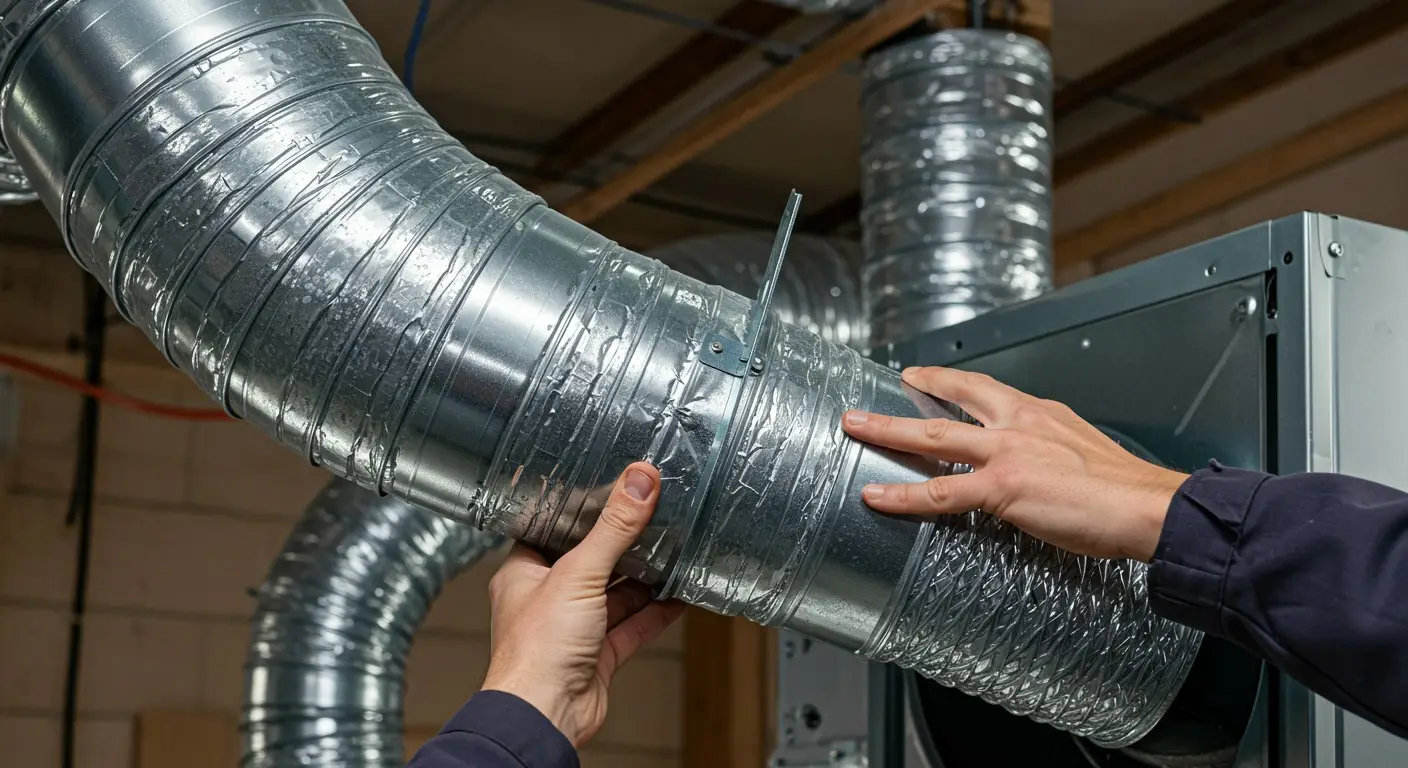
The Professional Installation Process: Step-by-Step
Understanding the installation timeline helps homeowners prepare for the work ahead. While every home in Raymore presents unique structural challenges, the workflow follows a disciplined approach to ensure quality and safety.
- Site Assessment and Design: Technicians first evaluate the existing infrastructure. This involves mapping out the most efficient routes for supply and return runs. If the current layout causes static pressure problems—which can kill a blower motor—the new design will correct these airflow bottlenecks.
- Removal and Disposal: Old, contaminated, or collapsed ductwork is carefully removed. Great care is taken to protect your flooring and furniture during this phase. The old materials are hauled away, leaving you with a clean slate.
- Plenum and Trunk Line Installation: The "heart" of the system, the supply and return plenums, are attached to the air handler. The main trunk line is then suspended and secured. This main artery must be rigid and perfectly aligned to facilitate smooth airflow.
- Branch Line Routing: Smaller ducts, known as branch lines, are run from the trunk to individual vents. Rigid pipe is preferred for long runs to reduce friction, while flexible ducting may be used for short, difficult connections to reduce noise transfer.
- Sealing and Testing: Before walls or ceilings are closed up (in renovation scenarios) or insulation is applied, the system is tested for leaks. A pressure test confirms that the air remains inside the system until it reaches the register.
- Final Commissioning: The system is powered on, and technicians measure static pressure and airflow velocity at the registers. This validates that the installation meets the design specifications.
Deciding Between Duct Repair and Full Replacement
Homeowners often hesitate between patching an existing system and investing in a new one. While repairs are suitable for minor disconnected joints or isolated leaks, there are specific scenarios where full replacement is the only financially sound decision.
Consider replacement if your system exhibits the following:
- Age of Materials: Ductwork has a lifespan. If your ducts are over 15 to 20 years old, insulation liners may be deteriorating and releasing fiberglass particles into the air. Old tape and mastic dry out, leading to widespread failure that spot repairs cannot fix.
- Incorrect Sizing: If you have upgraded your furnace or AC unit recently but kept the original ducts, the system may be mismatched. Modern high-efficiency equipment requires different airflow volumes than older units. If the ducts are too small, the new equipment will overheat and fail prematurely.
- Pest Infestation or Mold: If rodents have nested in the ducts or if moisture has led to extensive mold growth inside the liner, cleaning is rarely 100% effective. Replacement is necessary to ensure the health of the household.
- Structural Collapse: Flex ducts in attics can collapse or get crushed over time. Once the internal wire helix is damaged or the plastic liner is torn, the restriction acts like a kink in a garden hose, completely blocking airflow.
- Severe Efficiency Loss: If your utility bills are skyrocketing despite having a good HVAC unit, your ducts could be losing up to 30% of your conditioned air into the attic or crawlspace. When the cumulative loss exceeds the cost of financing a new system, replacement is the logical economic choice.
Local Installation Considerations: Climate and Codes
Installing ductwork in this region requires specific attention to environmental factors. The climate here swings from humid, sweltering summers to freezing winters. This drastic variation impacts how ductwork must be installed and insulated.
In the summer, unconditioned spaces like attics can reach temperatures well over 120 degrees. If the cold air supply ducts running through these spaces are not heavily insulated and vapor-sealed, they will sweat. This condensation can drip onto ceilings, causing water damage and creating a breeding ground for mold. Professional installation prioritizes high R-value insulation on all accessible ductwork to prevent this thermal transfer.
Local building codes in the area also dictate specific requirements for safety and efficiency.
- Fire Safety: Codes often require fire dampers or specific materials when ducts pass through garage walls or between floors to prevent fire spread.
- Venting Requirements: Combustion air requirements for gas furnaces must be met to prevent carbon monoxide back-drafting. A new duct system must not interfere with the safe operation of gas appliances.
- Permitting: Major modifications to HVAC systems usually require a permit. Licensed contractors handle the administrative burden, ensuring that the work passes municipal inspections and adheres to the latest energy codes.
By hiring All Day Comfort Heating and Cooling LLC, you ensure that every foot of ductwork is installed in full compliance with these local regulations, protecting both your property value and your family's safety.
The Impact of Airflow on Equipment Longevity
Many homeowners view ductwork as passive tubes, but they are an active component of the HVAC system's respiratory system. The relationship between the ducts and the mechanical equipment is critical. Restricted airflow is the number one killer of compressors and heat exchangers.
When ducts are undersized or pinched, the system suffers from high static pressure. This forces the blower motor to work harder to push air, leading to overheating and electrical failure. In cooling mode, low airflow causes the evaporator coil to freeze, potentially sending liquid refrigerant back to the compressor—a catastrophic failure. In heating mode, restricted airflow causes the heat exchanger to overheat, which can lead to cracks and safety shutdowns.
Investing in correct installation prevents these expensive mechanical failures. A system designed with the principles of aerodynamics allows the HVAC equipment to run at lower RPMs (if variable speed) or simply run for shorter cycles, extending the life of the furnace and air conditioner by years.
Advanced Duct Materials and Configurations
Not all ducts are created equal, and the choice of material affects performance, air quality, and noise levels. A professional assessment will determine the right mix of materials for your specific property structure.
- Sheet Metal: The gold standard for durability. Galvanized steel ducts are smooth, inhibiting mold growth and offering the least resistance to airflow. They are ideal for trunk lines and exposed ductwork.
- Fiberglass Lined: These are sheet metal ducts with an internal fiberglass liner to dampen sound. They are often used in commercial applications or noisy residential zones, though they require careful maintenance to prevent the liner from deteriorating.
- Flexible Ductwork: Tube-shaped ducts made of wire and plastic. While convenient and less expensive, they must be installed with minimal sags and turns. Poorly installed flex duct is a major cause of airflow restriction.
- Fiberboard: Compressed fiberglass strands bonded with resin and covered with a foil laminate. These provide built-in insulation and soundproofing but are less durable than metal and more susceptible to moisture damage.
The configuration also matters. A "radial" system, where each run comes directly off the plenum, works for small footprints. An "extended plenum" system is more common for larger homes, maintaining pressure across long distances. Your installer will select the geometry that best serves your floor plan.
Why Professional Design Trumps DIY Solutions
It is tempting to look at ductwork as a simple assembly project, but the physics of air movement is complex. "eyeballing" duct sizes leads to unbalanced systems where upstairs rooms are hot while the basement is freezing.
Professional installers utilize specific friction rate charts and equivalent length calculations. Every fitting—whether an elbow, a wye, or a boot—adds resistance to the flow. A professional calculates this resistance to ensure that the fan has enough power to push the air to the furthest register.
Furthermore, professionals understand return air pathways. A common failure in amateur installations is insufficient return air. If the system pushes out 1200 CFM (cubic feet per minute) of air but can only pull back 800 CFM through the return vents, the system creates negative pressure. This sucks unconditioned, dusty air from outside the house through cracks in windows and doors, degrading indoor air quality and efficiency.
Secure Your Home Comfort and Efficiency
Inefficient ductwork is a silent drain on your bank account and a constant source of frustration. Upgrading your air distribution system is one of the most effective ways to improve indoor air quality, enhance comfort, and lower energy costs immediately. You do not have to live with hot spots, cold drafts, or noisy vents.
Take control of your home’s climate today. Our team is ready to evaluate your current system and provide a clear, actionable plan for improvement. All Day Comfort Heating and Cooling LLC is dedicated to delivering precision installation that stands the test of time.
Call us now to schedule your ductwork inspection and start enjoying consistent comfort in every room.
Contact Us
customer reviews
Areas We Serve




Copyright © 2026 All Day Comfort Heating and Cooling.
All rights reserved.
